






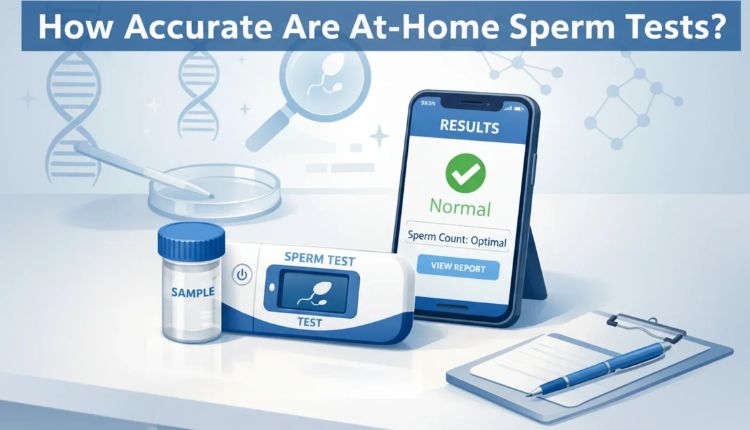
Walk through the at-home testing aisle online and the choices look almost interchangeable: a discreet box, a promise of private results, a reassuring graphic of a sperm cell. Look a little closer and the differences matter a great deal. Some kits give a simple pass-or-fail reading, others map several semen parameters, and a few are really postal sample kits dressed up as instant tests. For a man trying to make sense of his own fertility, knowing which question a kit can answer is more useful than any marketing claim on the front of the pack.
This is a buying guide rather than a clinical manual. The aim is to set out the practical criteria that genuinely distinguish home sperm tests from one another, so the decision rests on what a kit measures and how repeatable it is, not on packaging.
Why so many men are testing at home first
Fertility is still framed in many conversations as a female concern, yet the data points the other way. The British Association of Urological Surgeons notes that around one in seven UK couples have difficulty conceiving, and that in roughly half of these couples a contributing factor may sit with the male partner. Broader reviews put male-factor involvement at somewhere between 30 and 50 per cent of cases. Those figures are part of why at-home screening has become a sensible first step: it is private, it removes the awkwardness of a clinic visit for an initial look, and it can prompt the right conversation sooner rather than later.
What a home test cannot do is settle the question on its own. It is best understood as a way to gather an early signal, not as a substitute for a clinical work-up where one is needed.
The three broad types of home sperm test
Most products on the UK market fall into one of three categories, and they answer quite different questions.
Threshold concentration tests
These give a binary result, typically indicating whether sperm concentration sits above or below a set cut-off. They are inexpensive and quick, but a single pass-or-fail figure tells you little about how sperm are actually moving, which is where a lot of the useful information lives.
Smartphone and app-based analysers
Here a small device works with a phone camera to record a sample and report more than one parameter. Because they capture movement rather than a static line on a strip, this category can describe motility as well as concentration, which makes the reading more informative for most users.
Postal kits analysed by a laboratory
With these, you collect a sample at home and post it for analysis. They can be thorough, but timing and transit conditions matter, and the convenience of testing on your own schedule is partly lost. They sit somewhere between a true home test and a clinic appointment.
Which semen parameters a kit actually reports
The single most important thing to check before buying is which numbers the kit will hand back. The World Health Organization’s sixth-edition reference values, published in 2021, give the benchmarks most reputable tests are designed around.
Concentration
Often the headline figure, concentration describes how many sperm are present per millilitre. The WHO 2021 lower reference limit is commonly cited as 16 million per millilitre. A concentration-only test can flag a low reading, but it stops there.
Motility, and the progressive-versus-total distinction
Motility is the share of sperm that are moving, and it is worth understanding that there are two figures. The WHO 2021 reference limits are usually reported as 42 per cent for total motility and 30 per cent for progressive motility, the latter describing sperm that are actively swimming forward. A kit that reports progressive motility is giving you a more meaningful picture than one that only counts movement of any kind.
Total motile sperm count
This combines volume, concentration and motility into a single figure for the number of moving sperm in the whole sample. Many clinicians consider it one of the more informative measures, and a test that reports it is doing more work than a simple concentration check.
How a home reading compares with a laboratory semen analysis
It helps to be realistic about what at-home technology can and cannot match. Home and smartphone-based tests tend to agree most closely with laboratory analysis on simple binary outcomes, such as whether a value sits above or below a threshold. They are generally weaker as a stand-in for a full semen analysis, which is carried out under controlled laboratory conditions and assesses additional parameters a home device is not designed to capture. Read that way, a home result may indicate whether further investigation is worth pursuing, rather than delivering a complete fertility assessment.
Why one reading is rarely the whole story
Even a good test taken once can mislead, because semen quality naturally varies from sample to sample. This is not a flaw in the kit so much as biology. BMJ Best Practice notes that male-factor infertility is generally identified only when abnormal parameters appear across two semen analyses taken about a month apart. The practical takeaway for anyone buying a home test is that a single low or high reading is a prompt to test again, not a verdict. A figure below a reference limit does not mean conception is impossible, and a figure above it is not a guarantee.
That single point reshapes the buying decision. A kit you can realistically repeat two or three times is more useful than a one-off test that leaves you reacting to a number that might shift on the next sample.
A practical checklist before you buy
Four questions cut through most of the marketing.
- What does it measure? Concentration only, motility only, or several parameters including total motile sperm count. More parameters generally mean a more useful reading.
- Does it map to recognised reference values? Look for a test designed around the WHO 2021 limits rather than vague language about “normal” results.
- Can you repeat it affordably? Because a single sample may not reflect your usual pattern, the cost per test, not just the headline price, is what matters over a sensible testing window.
- Does it tell you when to seek clinical advice? A good kit positions itself as screening and points you towards a GP or clinic when a result warrants it.
Where a multi-parameter, repeatable kit fits
This is the context in which a smartphone-based option earns its place. As one example from the UK market, the ExSeed home testing system works with a phone camera to analyse a sample and report concentration, motility and total motile sperm count, rather than a single pass-or-fail line. Usefully for the repeat-testing point above, ExSeed itself recommends testing semen quality twice, more than a week apart, with a further check around a month later, and sells multi-test packs designed to make that affordable, with a two-test pack listed at �94.99 and larger packs bringing the per-test cost down. If you want to see how a multi-test option is structured, ExSeed’s sperm test kit is a reasonable reference point for what a repeatable, multi-parameter approach looks like.
The wider principle holds regardless of brand: a kit you can use more than once, that reports the parameters that actually matter, is better suited to the way semen quality behaves than a single snapshot.
Reading a home result without overreacting
However a kit is built, the calmest approach to the result is the same. Treat a first reading as one data point. If it sits below a reference limit, repeat the test after a reasonable interval and under similar conditions before drawing conclusions, and bring a GP into the conversation if low readings persist or if you have been trying to conceive for a while without success. A home test is there to inform that conversation, not to replace it.
The takeaway
Choosing a home sperm test kit comes down to matching the test to the question. If you only want a rough flag, a threshold test will do. If you want a reading that reflects how sperm are actually moving and that you can repeat as the science suggests you should, a multi-parameter, app-based kit aligned with WHO reference values is the better fit. Either way, the most important habit is to read any single result in proportion, and to use it as the start of a more informed decision rather than the end of one.