






Imagine the scene: You have just spent months selecting the perfect slabs of Travertine or Carrara marble. The veins are exquisite, the finish is honed to perfection, and the room looks like a page out of a design magazine. You go to bed happy.
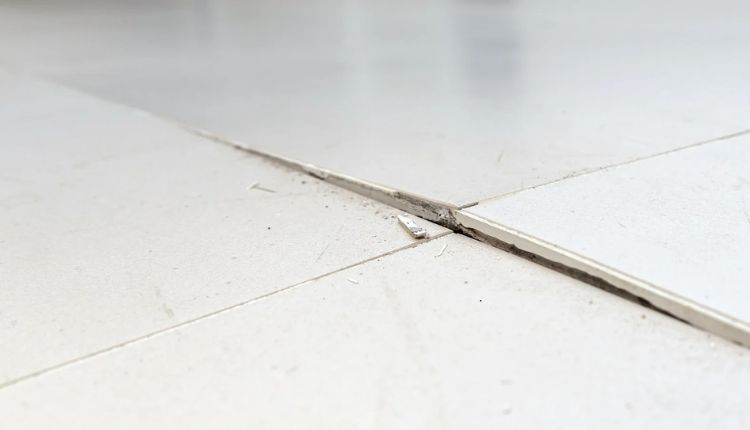
Six months later, you walk into the room and hear a faint click. You look down, and there it is—a jagged, hairline fracture running right through the center of your favorite tile. You didn’t drop a bowling ball. There was no earthquake. So, why did your stone fail?
The answer usually lies beneath your feet, buried in the dark, dusty space between the floor joists. It is a failure of physics known as “deflection,” and it is the silent killer of natural stone.
The War Between Wood and Stone
The fundamental problem with modern residential construction is that we are trying to marry two materials that hate each other.
The skeleton of most homes is built from wood—pine or fir joists. Wood is organic and flexible. It is designed to bend under load and bounce back. When you walk across a wooden floor, it microscopically dips and recovers. This “bounce” is acceptable for carpet, vinyl, or even wood planks, which are flexible enough to ride the wave.
Stone, however, is a sedimentary or metamorphic rock. It is rigid. It has zero tolerance for bending. It possesses high “compressive strength” (you can crush it), but very low “tensile strength” (you cannot stretch or bend it).
When you glue a rigid stone to a flexible wood subfloor, you create a composite sandwich. When you walk on it, the wood bends. The stone tries to bend with it, but it can’t. Instead, the shear force snaps the stone at its weakest point to relieve the stress.
The “L/360” Myth
Contractors and architects often talk about “code.” The standard building code for floor stiffness is usually expressed as a ratio: L/360.
This formula calculates how much a floor is allowed to bend over a specific span. For a floor span of 15 feet (180 inches), a deflection rating of L/360 means the floor can bend 0.5 inches in the center under a full load.
For a ceramic tile, a half-inch bend might be survivable. But for natural stone, it is catastrophic.
The natural stone industry standard is twice as strict: L/720. This means the floor needs to be twice as stiff as a standard home build. If your contractor installs natural stone on a standard L/360 subfloor, they are practically guaranteeing a future crack. The floor is strong enough so it won’t collapse (strength), but it moves too much for the stone to survive (stiffness).
The “Uncoupling” Solution
So, how do we stop the physics of the house from destroying the floor? We have to separate them.
In the old days, masons used a “mud bed”—a thick layer of sand and cement reinforced with wire mesh. This thick slab acted as a monolithic buffer, absorbing the movement of the wood so the stone wouldn’t feel it.
Today, we use technology called “uncoupling membranes.”
These are orange or blue plastic mats with geometric cavities, adhered between the plywood and the stone. They work on a simple but brilliant principle: they create a “slip plane.”
When the wood subfloor expands, contracts, or deflects, the bottom of the membrane moves with it. However, the top of the membrane (where the stone is glued) remains stationary. The membrane stretches internally, absorbing the shear stress like a shock absorber. It literally “uncouples” the finished floor from the structure of the house.
The Weight of the Matter
Beyond deflection, there is the simple issue of dead load. A 1.25-inch granite slab is heavy. A 12×24 limestone tile is heavy. When you add layers of plywood, cement board, mortar, and stone, you are adding thousands of pounds to a room that was designed to hold a sofa and a TV.
Often, the crack isn’t from the floor bouncing; it’s from the joists permanently sagging under the new weight (creep). Before a single tile is laid, a structural audit is required. This might mean “sistering” the joists (bolting new wood to the old) or adding blocking to stiffen the entire assembly.
Conclusion
The beauty of natural stone is its permanence. It is the material of mountains, meant to last for geological eras. But when we bring that mountain inside and place it on top of a wooden box, we have to respect the engineering required to keep it there.
A crack in a stone floor is rarely a defect in the rock itself; it is almost always a receipt for a shortcut taken in the substrate. The true art of stone flooring installation isn’t just in how neatly the tiles are cut, but in the rigorous, invisible preparation that ensures the floor feels as solid underfoot as the ground it came from.