






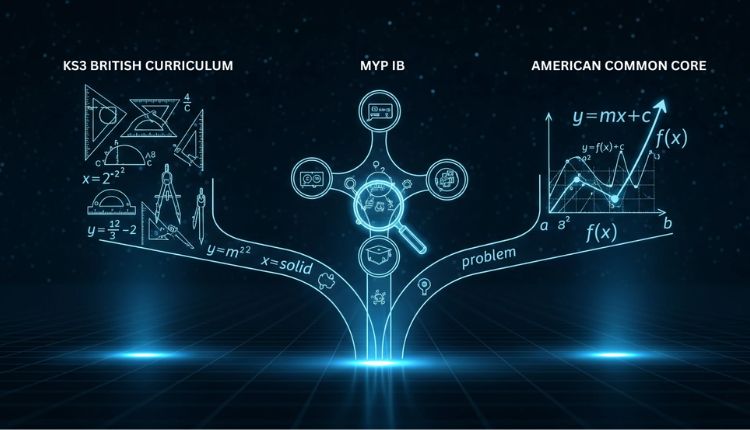
Mathematics has always been a core subject, but in today’s data-driven and technology-focused world, its importance has grown significantly. Within the International Baccalaureate Middle Years Programme (MYP), maths is designed not only to build numerical skills, but also to develop logical thinking, problem-solving abilities, and confidence in applying mathematics to real-life situations.
For many students, however, MYP Maths can feel demanding due to its emphasis on understanding, reasoning, and communication rather than rote learning alone.
What Makes MYP Maths Different From Traditional Maths Programs
Unlike many national curricula, MYP Maths focuses on conceptual understanding and real-world application. Students are encouraged to explore mathematical relationships, justify their reasoning, and reflect on their problem-solving strategies.
Assessment tasks often require students to explain processes, apply maths in unfamiliar contexts, and use multiple approaches to reach a solution. This can be challenging, especially for learners transitioning from more procedural maths systems.
This is where guidance from experienced MYP maths tutors can be particularly valuable. With structured support, students learn how to interpret assessment criteria, communicate their thinking clearly, and approach complex problems with confidence.
You can learn more about personalized academic support from experienced MYP maths tutors who understand the IB framework and its assessment expectations.
Key Skills Students Develop Through MYP Maths
MYP Maths is designed to help students build a wide range of transferable skills that support long-term academic success. These include:
- Logical reasoning and structured problem solving
- Clear mathematical communication using correct terminology
- Application of maths to real-world and interdisciplinary contexts
- Reflection on methods and accuracy
These skills are not only essential for future IB subjects, but also for careers in science, economics, technology, and many other fields.
Common Challenges in MYP Maths
Many students find MYP Maths more demanding than expected. Common difficulties include:
- Explaining mathematical reasoning in written form
- Applying familiar techniques to unfamiliar problems
- Understanding command terms and assessment criteria
- Balancing maths workload with other MYP subjects
Because marks are often awarded for method, explanation, and interpretation, even strong students can lose points if their reasoning is unclear or incomplete.
Targeted academic support helps students understand what examiners are looking for and how to structure responses effectively.
How MYP Maths Prepares Students for the IB Diploma
One of the key advantages of MYP Maths is how effectively it prepares students for the IB Diploma Programme. Students develop habits of thinking that align closely with IB expectations, including justification, reflection, and analytical depth.
Those who build strong foundations in MYP Maths often transition more smoothly into IB Maths courses, whether at Analysis and Approaches or Applications and Interpretation level. They are more comfortable with multi-step problems, mathematical language, and independent learning.
The Value of Personalized Maths Support
Every student approaches maths differently. Some excel in calculations but struggle with explanations, while others understand concepts but lack confidence in exams. Personalized tutoring allows teaching to be adapted to individual needs, learning styles, and academic goals.
Effective support focuses on building understanding rather than shortcuts. This helps students become independent learners who can apply maths confidently across subjects.
Why Early Support Makes a Lasting Difference
Addressing gaps early prevents frustration later. When students receive timely guidance, they develop confidence, resilience, and a positive attitude toward mathematics.
With the right approach, MYP Maths becomes more than just a subject. It becomes a tool for thinking critically, solving problems, and preparing for future academic challenges in the IB and beyond.