






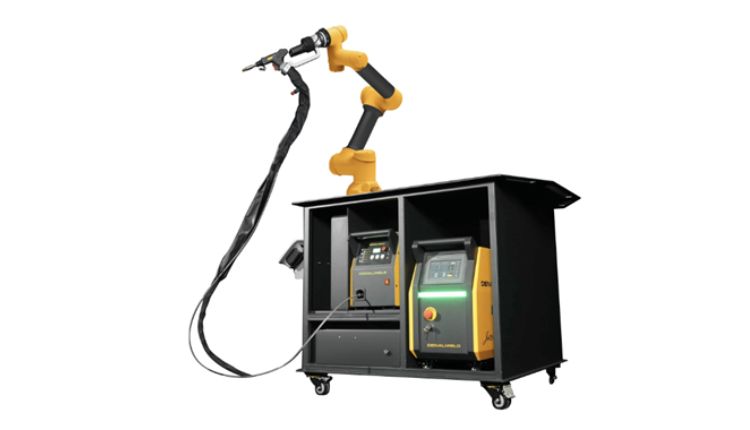
As global manufacturing continues shifting toward automation, efficiency, and smart technologies, welding remains one of the most important processes driving industrial productivity. However, many businesses still struggle with limited skilled labor, rising production demands, and the need for consistent weld quality across different product lines. Collaborative robots, or cobots, have emerged as a solution bridging the gap between manual labor and fully automated welding systems.
Unlike traditional robots, cobots are designed to work safely alongside humans making advanced automation more accessible. Today, cobot welding is gaining momentum across industries due to its adaptability, ease of use, and lower barrier to entry. But what does the future look like for this technology? This article explores emerging trends in collaborative robot welding and how these advancements will influence smart manufacturing in the coming years.
Why Cobot Welding Matters in Modern Manufacturing
Manufacturers everywhere face several pain points:
- Shortage of experienced welders
- Pressure to deliver high-quality welds at faster speeds
- Increasing demand for flexible automation
Cobot welding helps address these challenges by combining robotic consistency with human oversight, offering a scalable and cost-effective solution.
Increasing Integration With AI and Machine Learning
Artificial intelligence is set to transform cobot welding even further.
How AI will enhance cobot performance:
- Real-time adaptive welding: AI-powered sensors will allow cobots to adjust travel speed, torch angle, and voltage automatically based on material conditions.
- Predictive defect detection: Machine learning models can analyze patterns to identify potential issues such as porosity or lack of fusion before they occur.
- Automated parameter optimization: AI can choose ideal settings for different metals, thickness levels, or joint designs.
According to McKinsey, AI-driven automation could boost manufacturing productivity by up to 30% in the next decade making cobot welding a major beneficiary.
Growth of Plug-and-Play Welding Solutions
As demand for cobot welding rises, manufacturers are making systems even more user-friendly.
Future plug-and-play advancements:
- Pre-programmed weld paths for common joints
- Drag-and-teach programming for beginners
- Modular torch attachments
- Quick-change welding heads
These advances make cobot systems accessible even for smaller shops without robotics experts.
Expansion of Handheld-to-Cobot Hybrid Welding
One of the fastest-growing trends is the hybridization of manual and automated welding. Instead of choosing between handheld systems and fully automated cells, manufacturers are combining both approaches.
Benefits of hybrid setups:
- Operators can perform complex welds while cobots handle repetitive tasks
- Faster switching between manual and automated modes
- Reduced operator strain and improved weld consistency
Hybrid solutions are especially beneficial for fabrication shops that handle custom or small-batch production.
Improved Safety Features for Human–Robot Collaboration
Cobot safety technology is advancing rapidly, making collaboration smoother and safer.
Future safety enhancements include:
- AI-powered collision detection
- Enhanced force-limiting sensors
- Automatic weld shutoff when unexpected movement is detected
- Advanced enclosure-free workstations
These innovations will enable cobots to operate closer than ever to human welders, optimizing space and workflow.
Sustainable Welding With Energy-Efficient Cobots
Manufacturers are increasingly prioritizing sustainability and cobot welding supports this shift in several ways:
- Reduced power usage compared to large industrial robots
- Lower heat input, leading to less material waste
- Fewer consumables required
- More consistent welds, reducing scrap and rework
According to the IEA, energy-efficient automation will play a major role in helping industries reduce emissions by 2030.
Greater Adoption in Small and Medium-Sized Enterprises (SMEs)
Once limited to large factories, cobot welding is now expanding rapidly among small and medium businesses.
Reasons for growing SME adoption:
- Affordable pricing compared to full automation
- Small physical footprint
- Quick deployment and training
- The ability to move the cobot between stations
SMEs will contribute significantly to the rising global adoption of cobot systems as accessibility improves.
Small-Scale vs. Large-Scale Cobot Welding: Future Outlook
| Category | Small-Scale (SMEs) | Large-Scale (Enterprise) |
| Automation Level | Moderate | High |
| Focus | Flexibility, versatility | Speed, volume |
| Use Cases | Custom fabrication, repair | Automotive bodies, large assemblies |
| Future Trend | More plug-and-play tools | Fully autonomous weld stations |
Both scales will evolve, but in different directions one toward flexibility, the other toward full automation.
Multi-Process Cobot Welding Systems
The future will see cobots that can handle multiple tasks beyond welding, such as:
- Laser cleaning
- Cutting and trimming
- Material handling
- Inspection and measurement
This multifunction capability transforms cobots into all-in-one smart manufacturing assistants.
Cloud-Connected Welding and Remote Monitoring
Smart factories rely heavily on connectivity and cobots will follow suit.
Cloud-based capabilities will include:
- Remote diagnostics
- Performance dashboards
- Weld-quality analytics
- Auto-updates for improved algorithms
This will help maintenance teams predict issues before downtime occurs.
As collaborative welding continues advancing, many manufacturers are looking for equipment that supports precision, efficiency, and modern automation workflows. Solutions from brands like Denaliweld are designed to complement these evolving needs, offering durable and reliable welding systems suitable for cobot-integrated environments.
Conclusion
Cobot welding is becoming one of the most transformative technologies in modern manufacturing. As AI, automation, cloud connectivity, and lightweight robotics continue to improve, cobot welding systems will play an increasingly central role in production environments of all sizes. Whether supporting high-volume assembly lines or flexible fabrication shops, these systems offer unmatched efficiency, safety, and repeatability. By understanding upcoming trends and integrating the right tools and processes, you can position your operation to thrive in the next generation of smart manufacturing where cobot welding is a cornerstone of innovation, productivity, and long-term competitiveness.