






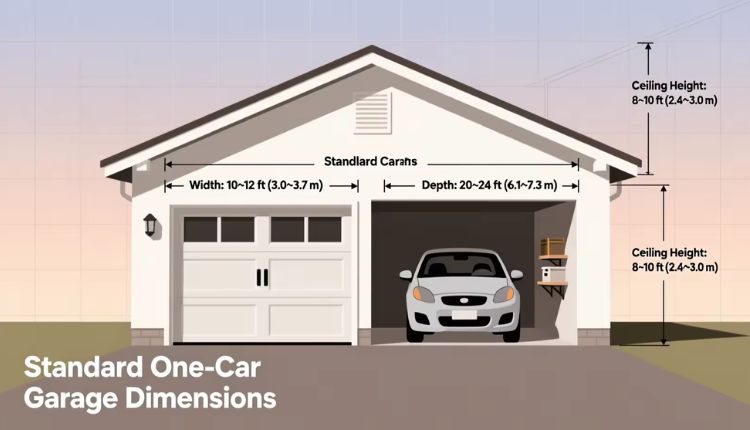
Figuring out the right garage size sounds straightforward until you actually start planning one. You know your car fits in certain spaces, but should your garage be just big enough, or should you think bigger? Most homeowners realize too late that they should have added another foot or two, especially when they’re squeezing past their vehicle to grab something off a shelf or struggling to open the car door without dinging the wall.
The truth is, garage sizing depends on more than just your vehicle’s measurements. It comes down to how you’ll actually use the space day-to-day and what else you need to store besides your car.
Standard dimensions you need to know
The most common single car garage measures 12 feet wide by 20 feet deep. This gives you 240 square feet to work with, which handles most sedans and compact SUVs without much trouble. Your car gets in, the door closes, and technically everything works.
But here’s where things get interesting. Once you factor in real-world use, that 12×20 footprint starts feeling tight. You’ll have maybe six inches on either side of your vehicle if you park perfectly centered. That’s not much room for error, and it definitely doesn’t leave space for the lawn mower, bicycles, or those bins of holiday decorations.
That’s why many people opt for 14×24 dimensions instead. The extra width and depth make a noticeable difference. If you’re considering extra storage or even thinking about a prefab garage with loft, those additional square feet become essential. A loft gives you overhead storage without eating into your floor space, but you need the base dimensions to support it properly.
The largest standard single car garage runs 16×24. At 384 square feet, this size gives you genuine breathing room. You can park, open your doors fully, and still have wall space for shelving or a workbench.
Minimum vs recommended sizes
The absolute minimum for a single car garage sits at 10×18, but this only works for the smallest vehicles. Think Smart Cars or subcompact models. Most cars today, even compact ones, measure close to 15 feet long and 6 feet wide. When you add in door mirrors, you’re looking at closer to 7 feet of width.
Here’s what actually fits in different sizes:
1. 10×18 garage works for motorcycles, ATVs, or extremely small cars;
2. 12×20 garage accommodates most sedans and smaller SUVs with minimal clearance;
3. 14×22 garage handles mid-size SUVs and leaves room for basic storage;
4. 14×24 garage fits full-size pickups and includes space for tools and equipment;
5. 16×24 garage accommodates large trucks and provides comfortable workspace.
The difference between minimum and recommended comes down to daily frustration versus daily ease. Sure, you can technically fit a vehicle into a smaller space, but you’ll regret it every time you bump your door against the wall or can’t walk around your car without turning sideways.
Why bigger isn’t always wasteful
Some people worry that building a larger garage wastes money and property space. But consider what happens over time. Vehicles change, storage needs grow, and that extra room becomes valuable in ways you didn’t anticipate.
A slightly oversized garage serves multiple purposes. It protects your vehicle from weather while doubling as a workshop, storage area, or hobby space. Many homeowners use their garages for woodworking, as home gyms, or for storing seasonal equipment like kayaks and camping gear.
The backyard building company Storage Sheds And Garages often recommends sizing up by one increment from your minimum requirements. Their experience shows that customers who choose 14×24 over 12×20 report much higher satisfaction long-term. The extra square footage costs relatively little during construction but delivers ongoing value for years.
Door dimensions matter too
Your garage door size directly affects how easily you can park. Standard single car garage doors measure either 8 or 9 feet wide and 7 feet tall. The 9-foot width gives you more clearance and makes daily parking less stressful.
For taller vehicles, including trucks and SUVs with roof racks, an 8-foot tall door works better than the standard 7-foot height. Some garages need even more clearance depending on what you drive.
Door width breaks down this way:
1. 8 feet wide handles small to mid-size cars but feels cramped;
2. 9 feet wide accommodates most standard vehicles comfortably;
3. 10 feet wide provides generous clearance for wider trucks and SUVs.
Planning for your specific needs
Before finalizing dimensions, measure your actual vehicle from bumper to bumper and mirror to mirror. Then add these clearances:
1. At least 2 feet in front of and behind your vehicle for walking space;
2. Minimum 12 inches on each side for opening doors fully;
3. Extra depth if you plan to store items at the back wall.
Think about ceiling height too. Standard garages have 8 to 10 feet of overhead clearance. If you want to install a ceiling-mounted storage system or work underneath your vehicle, higher ceilings make sense.
Your garage should also account for future changes. Maybe you drive a sedan now but plan to buy a truck later. Or perhaps you’ll want to add a workbench once you retire. Planning for these possibilities now prevents expensive modifications later.
The right single car garage size balances your current needs with future flexibility. It gives your vehicle protection while providing enough extra space to make the garage genuinely useful rather than just barely functional. When you can move freely, access your storage easily, and park without stress, those extra few feet prove their worth every single day.